She was to stand, robed and gigantic, her torch at once a succor for incoming ships and a beacon to the world. Her sculptor, Frédéric-Auguste Bartholdi, was drawn to monumental forms. As a young man he had travelled up the Nile and photographed the stone colossi built to guard a pharaoh’s tomb. When he returned to Egypt a decade later, another project of epic ambition was nearing completion, the fulfilment of an ancient dream: carving a waterway through the desert to join the Red Sea and the Mediterranean, collapsing the scale of the world. Bartholdi tried to persuade the Khedive that a new colossus should mark the entrance to this Suez Canal: a lighthouse in the guise of a fellaha, one of the humble countrywomen he had encountered on his travels. He called it Egypt Enlightening Asia. But the Khedive demurred; the canal had cost twice as much as planned. A few years later, as French liberals discussed how to commemorate the centenary of the American republic, Bartholdi reworked his design and named it Liberty Enlightening the World…
The story of Lady Liberty’s early life as an Egyptian fellaha is one I learned only recently. In 2024, shortly after moving to New York, I joined a walking tour of Lower Manhattan led by Asad Dandia, an urban historian and community organizer who has spent years deciphering the city’s palimpsest. Focused on a couple blocks of the Financial District, the tour of what was once known as “Little Syria” offered a counter-history that placed a community usually banished to the margins at the heart of American life. Besides the crypto-Egyptian statue, we learned that the first peace treaty signed by the United States was written in Arabic; that both the Vanderbilts and the Roosevelts descend from an infamous Muslim pirate; and that among the habitués of the Dunkin’ Donuts at 19 Rector Street are those who believe that its grounds remain blessed on account of the makeshift mosque, established by an Ottoman consul, that once stood at that address.
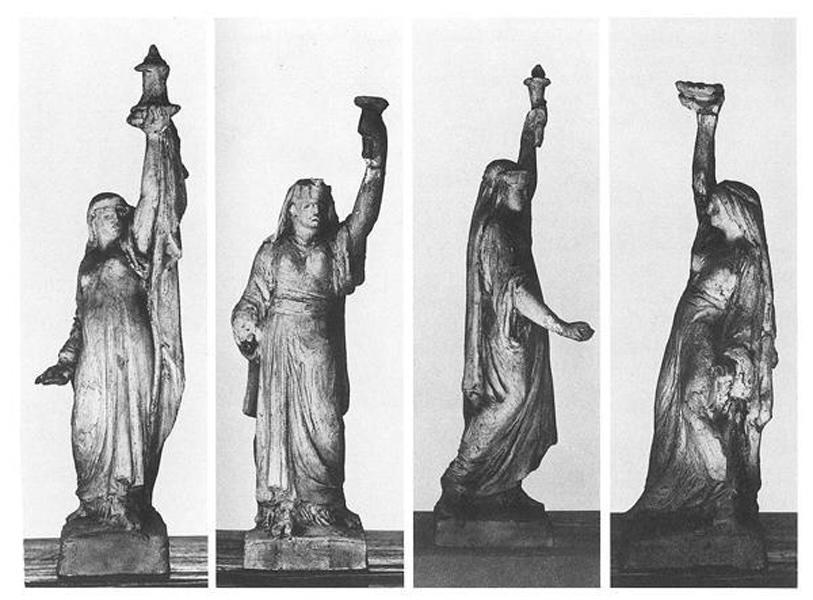
Announcement poster for 2010 group show at Galerie Buchholz Köln, Germany. Courtesy Galerie Buchholz
A similar excavation of shadow histories is currently on view in Niyū Yūrk, a jewel box of an exhibition at the New York Public Library curated by Hiba Abid and devoted to Middle Eastern and North African presences in the city. The show gathers ship manifests, storefront photographs, club minutes, theater programs — paper traces of the people whom Dandia tracks in the streets. Of the many intriguing artifacts, my attention was drawn to the score for Amerika Ya Hilwa (America the Sweet, 1912), one of several patriotic ditties composed by a young Lebanese émigré, Alexander (Iskandar) Maloof, in response to a call for a new national anthem. Another Maloof piece, “For Thee, America,” was quickly adopted by schools and performed at graduations across the country. The refrain seems tender, almost bashful. While it is perhaps hard to imagine it soaring over a stadium, it is enough to know that this immigrant’s ode was sung for decades by children in some twenty states, including New York, where Maloof once led a choir of 500 students in rousing song.
—Yasmine Seale
Michael C. Vazquez: Can you talk a little about how you’ve chosen to frame the exhibition?
Hiba Abid: Well, it’s titled Niyū Yūrk, which is how “New York” sounds in Arabic…
Asad Dandia: The perfect name!
MV: What’s great about it is how it estranges the familiar — evens out the sonic terrain between “migrant” and “native.” Non-Arabic speakers are forced to stop and think about how to pronounce the name of the city. Like, how many syllables is that? Three? Two? Two-point-five? [Laughs] I listened to your interview on WNYC and the very well-intentioned host kept getting hung up on it. Which is to say: yes, the perfect name.
HA: Thank you! The exhibition is about Middle Eastern and North African lives in the city, as told through the materials that the library has collected — and failed to collect — about them. This is the first exhibition to draw from NYPL’s holdings on the subject, and I decided to work with the strengths and the gaps of the archive, which is really sprawling but uneven. There’s also a meta-story being told here about collecting practices: who decides what’s worth keeping, and what happens when the people making those decisions lack the linguistic or cultural knowledge to recognize what they’re seeing.
MV: So much depends on who’s doing the work.
HA: Exactly. The Oriental Division of the NYPL was founded in 1897 by scholars who were mostly interested in the past — Mesopotamia, Persia, Ancient Egypt — and subjects like Arabic poetry, lexicography…
MV: What you might call classical orientalism.
HA: With all that implies. But then at that very same moment, the city was seeing the first waves of immigration from the Middle East and North Africa. Those immigrants were building communities, starting businesses, making names for themselves. Publishing books and newspapers. Members of those communities were using the libraries… and some of them were donating materials, which made their way into the collection.
So, the first part of the exhibition, “Roads to New York,” looks at that early period and the people who came here — and about how they were perceived, documented, and categorized. For example, we show some of the famous Ellis Island portraits taken by Augustus Sherman and Lewis Hine, but we include the original descriptions that accompanied them, which ultimately migrated into the library catalog. It makes vividly clear how ethnographic those early perceptions of Middle Easterners were.
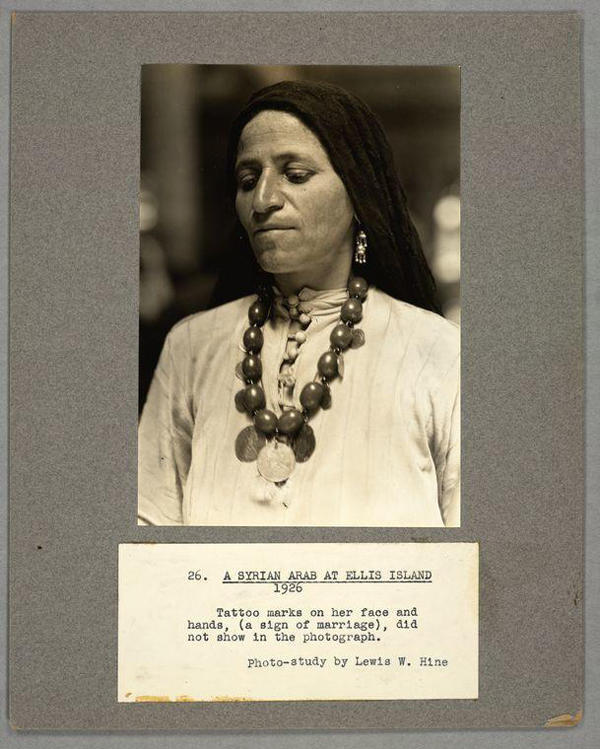
MV: Orientalized, even.
HA: Yes. Much of this perception had been shaped by the World Fairs in Chicago, Philadelphia, and St. Louis in the 1870s, 1890s.
MV: The Midway at the 1893 Columbian Exposition in Chicago was like a buffet of folkloric tropes — there was a Turkish village, an Algerian Theater, a Moorish Palace, and a “Cairo Street.” Huge pavilions.
HA: Many people from the Middle East and North Africa worked those fairs. It’s important to remember that people self-orientalized. Entertainers capitalized on their supposed exoticness, playing to Western audiences’ tastes.
MV: Can you talk about the study guide for aspiring immigrants? It looks like a sample test.
HA: They’re the answers you are advised to give to the questions you’re likely to get at Ellis Island. Each entry appears in English, Arabic, and phonetic English. It was important because there were trick questions! They would ask: “Do you believe in polygamy? Do you intend to practice polygamy?”
AD: Which was a question that was originally added in the 1890s, targeting Mormons. But it became like a trick question for Muslims. There are records of men being rejected because they didn’t know how to answer.
HA: One of them is in the exhibition: Mohamed Juda. He is the “Algerian Man” in the Ellis Island portraits.
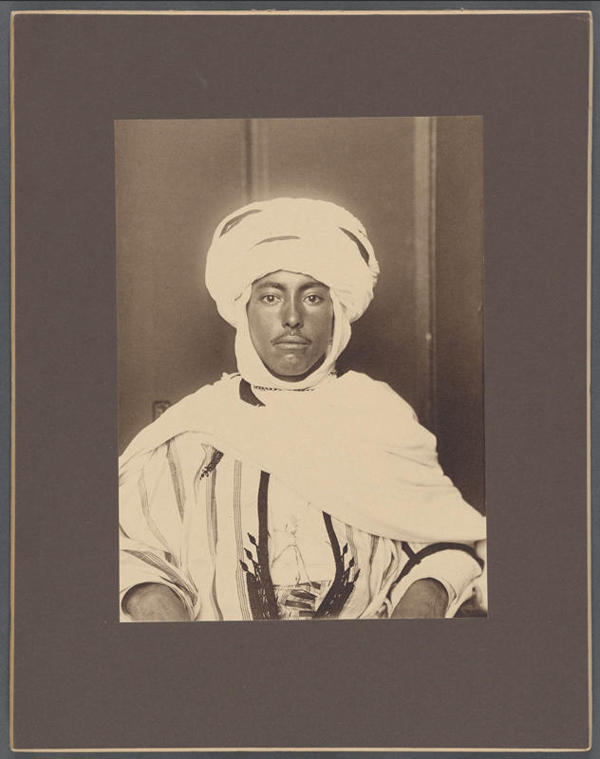
Gelatin silver print. Courtesy The New York Public Library
AD: He came over with a few friends, who made it through immigration fine. What’s interesting is that they were all on their way to meet a man named Martin Labé about finding work. And Labé, who was supposedly a Sephardic Jew from Algeria, was one of several Algerian men who lived in the tenement at 109 Washington Street in Lower Manhattan.
MV: Which was called Little Syria at the time?
AD: Exactly. And that building at 109 Washington is still there — it’s probably the last physical trace of that neighborhood, which was cleared out in the late 1940s to make way for the Battery Park Tunnel.
HA: There’s one other trace: the façade of what used to be St. George’s Church.
MV: At what point did people start calling that area Little Syria? And what did they mean by “Syria”?
HA: Well, the community dates back to the 1880s, but it would probably have been called the Syrian Colony or the Syrian Quarter in the local press. Either way, the name refers to Greater Syria, which was an Ottoman territory that included what is now Lebanon, Syria, Palestine, Israel and Jordan.
MV: I feel like there’s a whole history of nomination tied into the crises in the waning years of the Ottoman Empire…
HA: Absolutely. In the records at Ellis Island, people are constantly being misidentified. But they also self-identify in ways that no longer make sense to people. Someone like Khalil Gibran called himself Syrian, not Lebanese. It’s a historical term.
AD: The authorities weren’t sure how to categorize this community. In the census records maintained by another church in the neighborhood, they ranked the local demographics. Number one was “German,” number two was “Irish,” and number three was “Asiatic Turkey (Syria).”
MV: Obviously. [Laughter]
AD: Little Syria is usually remembered as a Christian Arab enclave, but there were Jews, Druze, Armenians, and Muslims who lived there, too.
HA: There’s a myth or legend about a mosque on Rector Street…
AD: Yeah, that one article from 1912, which describes a “Turkish chapel” on the third floor of a building, led by a Turkish imam. It seems like it was more of a prayer space, inside someone’s apartment; it doesn’t show up in any official records. But I did find evidence of Eid celebrations in the neighborhood a little later — there’s a 1926 article about an Eid event at 65 Washington St. with Russians, Poles, Yemenis, and Syrians all together. So you had this kind of multi-ethnic community, though by that time the Syrians had started moving to Brooklyn.
MV: Wait — Poles?! [Laughter]
AD: Yes! Polish Tatars. In fact, the first official mosque in New York City was founded by a Polish Tatar in the 1930s. It’s in Williamsburg. It’s still there!
MV: That’s wild. I imagine all this history and multiplicity is reflected in the archives?
HA: You have no idea. But there are so many uncatalogued things, too — photographs without any caption or context: portraits, party scenes, performances. We’ve actually been able to fill in a lot of this history just by talking to people. I live in Cobble Hill, Brooklyn, and there’s a man in the neighborhood named Mike Shaheen who was born on Atlantic Avenue in 1941. Everyone calls him Butchy. He’s a Lebanese Christian. Every Sunday he goes to church at Our Lady of Lebanon, then he goes to Oriental Pastry & Grocery, where he takes his coffee. When I met him for the first time, I’d been going through the papers of Ibrahim “Bobby” Farrah, a choreographer and scholar of Near Eastern dance, who had all these uncaptioned photos from community events. When I showed Butchy the photos, he was like, “That’s my aunt, those are my parents, that’s the Syrian Young Men’s Association down the street.” Mike seemed to know everyone in these party photos from his youth, and he shared all of that with me, helped me describe them. So now we have names on the labels. It’s not just, you know, “Unknown revelers, from the archive of Ibrahim Farrah.”
MV: I love everything about that, including the idea of someone singing “S-Y-M-A.”
AD: Atlantic Avenue is so important to our history here. I grew up in Brighton Beach, but as a kid I would take classes at the mosque on Atlantic Avenue, up by what is now the Barclays Center. I always wondered why there were so many Arab and Muslim businesses on Atlantic. Why there, of all places?
HA: Because it was right near the port. And there was a ferry from Little Syria that docked at Atlantic Avenue.
AD: Right! I only figured that out a few years ago — the direct transportation route from Lower Manhattan to Brooklyn. And since a lot of those businesses were involved in shipping goods overseas, it was a convenient location.
HA: Sahadi’s started in Little Syria in the 1890s and reopened on Atlantic fifty years later.
AD: There’s also a more challenging history to Atlantic Avenue. Do you know Tripoli? The Lebanese restaurant at Clinton Street?
HA: Of course.
AD: So Tripoli was actually bombed in 1981. The neighborhood was a site of conflict between Arabs and right-wing Jews in the 1970s and ’80s. Tripoli was across the street from where it is now; the building went up in flames, and one person died. The Jewish Defense League took credit for the bombing, supposedly in retaliation for the killing of an Israeli soldier in Gaza. The JDL was founded in the late ’60s by Meir Kahane, who was born in Brooklyn. He fled to Israel in 1971, after being convicted for making bombs at the summer camp he founded, but the JDL kept going. There’s a great biography of Kahane that gets into how his fascist politics were informed less by what was happening in Israel-Palestine than by the racial politics of New York. This was an era, you know, when you had very militant organizations like the Young Lords and the Black Panther Party. And Kahane was inspired by that kind of muscular self-determination, but with a right-wing bent.
MV: He was inspired by Black Power in general. The JDL’s slogan, “By whatever means necessary,” is just Malcolm X with extra syllables.
AD: And actually, when Kahane was assassinated in 1990, during a visit to New York, his killer was an Egyptian guy who attended the Islamic Center on Atlantic. The ethnic and racial tensions in the city were severe.
HA: When I first moved to New York, I remember being struck by how few Muslims I saw, compared to other cities I’ve lived in, like Paris or Tunis. They’re not very visible here. I remember going to Bay Ridge and finally feeling like, “Okay, I can belong to this city.” Not because I am passionately Muslim; it’s not about that. But there’s just something —
AD: A language or sensibility…
HA: Yeah. When you run into a Muslim on the street, there’s a subtle recognition that takes place. I don’t mean to romanticize, but these moments of shared recognition of a lived experience matter in a city like New York. Because Muslims seemed rather invisible here, except in places like Bay Ridge or Jackson Heights.
AD: Or Atlantic Avenue.
HA: Well, the neighborhood is extremely gentrified…
AD: Yeah, it’s definitely less residential. I doubt there’s a significant Arab population on that street. But it’s still plenty recognizable as a commercial district. Damascus Bakery, Sahadi’s, Oriental Pastry —
MV: Hadramout.
AD: Right. Hadramout, Yemen Café…
HA: I was talking to one of the owners of Yemen Café the other day, and he was sort of nostalgic and sad about how few Arab residents are left. I don’t know how many people can afford to live in the neighborhood anymore. You still see Yemeni families with the moms and their sisters and all the kids going to the park. I don’t know if they’re coming from elsewhere on account of the Islamic Center and the restaurants or whether they still live here. But it seems to me that something is vanishing.
AD: I think the center of gravity shifted to Bay Ridge some time ago.
HA: Yeah. I wanted to ask you, as someone who grew up here and came of age in the years after 9/11 — do you think the backlash against Muslims and Arabs we’ve been seeing these last couple of years is reminiscent of the post-9/11 era?
AD: Yes and no. There was a lot more direct infiltration by the NYPD after 9/11. They sent paid informants to spy on mosques, student groups, community events. That’s part of my own story — I started a charity organization when I was nineteen and it was infiltrated by a guy my own age, who’d reached out to me on Facebook.
MV: Insidious.
AD: Yeah. So that was the kind of Islamophobia that we faced then. But Muslims and Arabs have more of a presence in the city now. We can respond in a way that we couldn’t twenty-five years ago. We can talk back. There’s also a lot more solidarity from non-Muslims who came of age after 9/11 and saw all the things that we faced. They’re coming out and saying that the life of an Israeli Jew and the life of a Palestinian are equal in value. This should be obvious, right? But the dehumanization of Arabs and Muslims has been so intense that expressing really basic ideas is considered radical. And you know, I’ve been working to advance understanding of our communities for my entire adult life. But there were moments in the fall of 2023 where I was like, “Was any of this worth it? Did any of this work make a difference?”
HA: I had that same feeling. When I was working on the exhibition, I spent a lot of time up at Columbia University, going through Edward Said’s papers, reading his letters, manuscripts. I hadn’t realized how often he wrote outside academic spaces — for newspapers and magazines, including Bobby Farrah’s Arabesque — to reach a wider audience. He wrote about Palestine, yes, but also about our missing voices in institutions and the misrepresentation of our communities in American media — and yet despite all this work, it feels like we’re still fighting the same battles.
AD: I still have those moments sometimes.
MV: I think that the backlash against the backlash, if you will, was a big factor in Zohran’s election. As Hegel sort of said, it’s one battle after another…
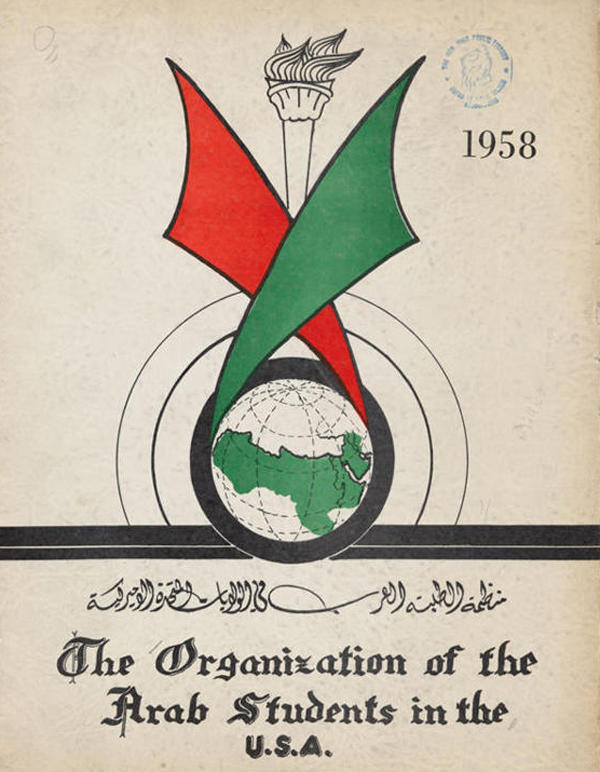
HA: There’s a publication in the show that speaks to this: the yearbook of the Organization of Arab Students in the USA, a national organization founded in Ann Arbor in 1952 and headquartered in New York City. We only have two of them; I wasn’t able to learn anything about how they ended up in the collection.
MV: I recognize that Picasso drawing.
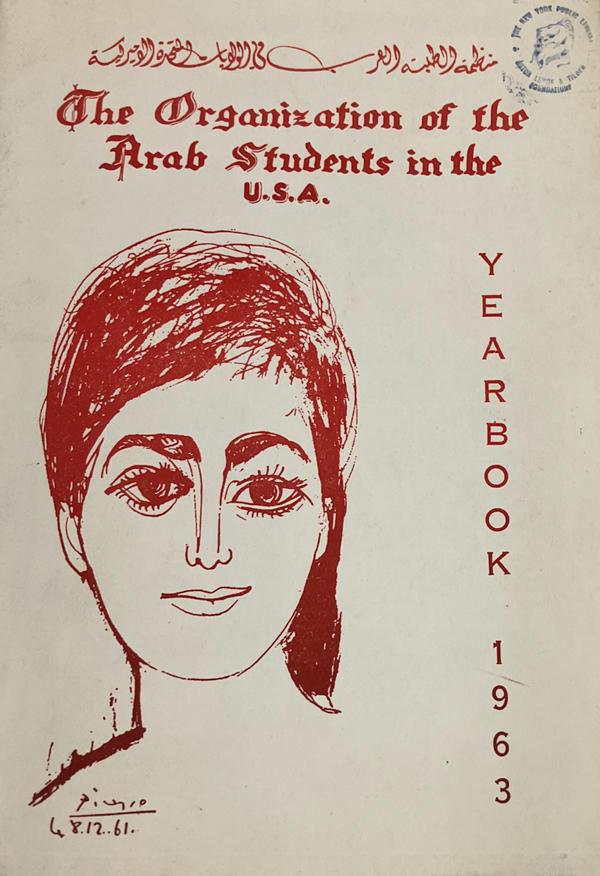
HA: That’s Djamila Boupacha, an Algerian nationalist who was tortured and raped by French soldiers during the Algerian War. Picasso drew that portrait as part of the international campaign to keep France from executing her in 1962, as the war was ending. It’s used here on the cover of the yearbook for 1963, when a delegation of newly independent Algerians came to the US and met with OAS groups in different states. The other one is from 1958, the year that Egypt and Syria merged to become the United Arab Republic. Inside there are photos from parties that various OAS chapters threw to celebrate the UAR. And the cover uses the colors of Pan-Arabism. Look how strong the red is, and the green.
MV: The logo is lettered by hand. It’s incredible.
AD: It’s beautiful.
HA: Yes. And the reason I included them in the exhibition is to show the history of Middle Eastern activism and transnational solidarity here in the city. There’s been so much criticism of the student activists on campus — “Oh, they’re getting it all from Tik Tok, blah blah blah,” like it came out of nowhere. The OAS was organizing around Palestine in 1963! I find these transnational conversations and mobilizations inspiring. It’s part of the beauty of New York, for me.
AD: I find inspiration in the black struggle, the black radical tradition. This is a community that has faced the worst of the worst for over four centuries, and yet still perseveres. And I mean, look at all the beauty that’s come out of black New York — so many cultural and social interventions. From the literature and art of the Harlem Renaissance to hip hop, the most popular and universal musical genre in the world — a language through which we can express our pains and dreams and grievances. It gives me a lot of hope. I think it’s no accident that my most popular tour is “Malcolm X’s Harlem.”
HA: By the way, the Schomburg Center at NYPL just acquired the first translation of The Autobiography of Malcolm X in Arabic, which was published in Lebanon in 1968 by Dar al-Adab.
AD: I would love to check that out. Malcolm continues to inspire so many people. Different kinds of people! I’ve had a conservative imam and a trans rights activist tell me that they see themselves in Malcolm — in his struggles, in his transformation.
MV: Is there a story behind the dictionary?
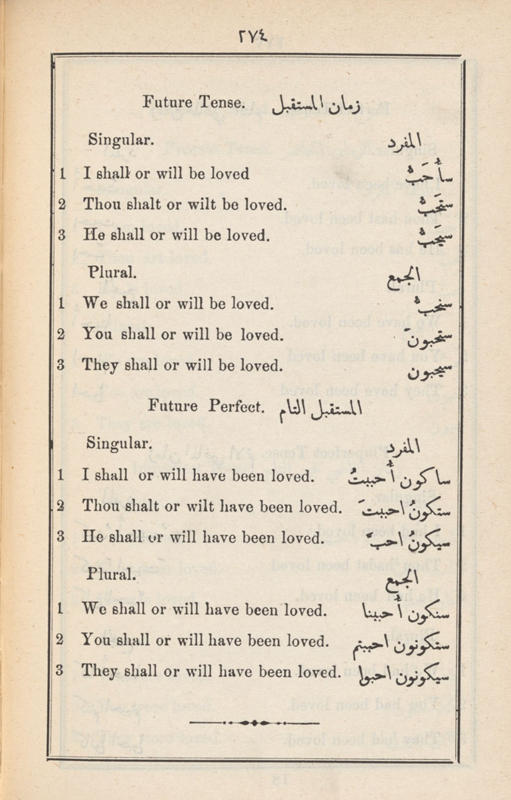
HA: Ah, it’s the first English–Arabic dictionary published in the US, back in 1895. Our copy is autographed by the author, Ibrahim Arbeely, to Andrew Carnegie. It’s a phrasebook for all the situations someone might find themselves in, like going to the post office or being invited over to an American family’s house. There’s a sequence in here that I find so moving: “I may be loved. I might be loved. I may have been loved.”
MV: Wow. That is a complete poem, conjugating longing. I love that Arbeely was like, “You’re going to need all of these tenses.”
Teaching the English Language), 1896. Courtesy The New York Public Library
AD: Well, there’s a lot of heartbreak in New York… [Laughter]
HA: There’s also a copy of Mikhail Rustum’s A Stranger in the West in the show, from 1895. It was the first Arabic travel book about the US, and it featurehas a full-page illustration of the Brooklyn Bridge. Middle Eastern immigrants seem to have been obsessed with the Brooklyn Bridge. When I took my dad, who’s a retired civil engineer, to see it, he couldn’t stop staring at it. He was fascinated.
AD: Me too, still. You know, when it was built it was the longest suspension bridge in the world, and one of the tallest structures.
HA: I really wanted to place immigrants’ perceptions of New York at the center of the show. We have a text by the Syrian socialist Niqula Haddad, written in 1908 during an economic recession, called A Painful Sight in New York. He says that human life here has no value if you don’t have money.
MV: Did you consider putting Sayyid Qutb in the show? [Laughs]
HA: I did, actually — I thought about him a lot when I was developing the third section of the show, “Impressions,” which considers New York as a site of admiration and possibilities, as well as one of indignation and rejection. Qutb’s 1951 article, “The America I Have Seen,” is hilarious. He talks about all the contradictions and oddities of American culture — how Americans eat, how they grieve.
MV: And their terrible haircuts. And jazz, for that matter. That piece features in a classic Bidoun essay, “The Muse of Failure.”
HA: There’s also a section in the show on performance and entertainment. Reza Abdoh, whose archive is at the Performing Arts library, is in there. It also features Halim El-Dabh, who was a pioneer of electronic music from Egypt. While studying agricultural engineering in Cairo, he would attend Zaar adorcism rituals in the city and record them. He then experimented on the tape in a studio, making electronic music using natural sounds — or, you could say, musique concrète — which he premiered at an art gallery in 1944.
MV: That’s amazing. But did you say exorcism?
HA: Adorcism. It’s actually the opposite of exorcism. Adorcism is a ritual intended to bring the spirits in, to help, rather than expel them. It’s a healing ritual.
MV: I love that.
HA: I have goosebumps just talking about it — the sounds and the music he makes in the 1950s is just insane. And his work complicates the genealogy of musique concrète, because El-Dabh was doing this kind of work several years before Pierre Schaeffer, who is usually considered the originator…
AD: That’s fantastic.
HA: He came to the States in 1950 and moved to New York in 1956. He composed the music for Martha Graham’s 1958 ballet, Clytemnestra, which Isamu Noguchi did the set design for. The story is that she originally commissioned El-Dabh to do just a small part of the score, which he did — and then after she listened to it, she asked him to do the whole thing. It’s quite epic, almost two and half hours of music. And in the last act, he incorporated ancient Egyptian elements into this Greek tragedy. He died just a few years ago. I think he’s so important.
MV: That’s incredibly cool. I don’t know how it is that I haven’t encountered him before.
HA: You should really check him out. One of my goals with the exhibition is for people to make discoveries — to find out about someone or something they would never know or think they would be interested in.
MV: Like… FM-2030? [Laughs]
HA: Exactly. Such a fascinating guy — athlete, lawyer, philosopher, polymath from Iran…
MV: Novelist, too. He wrote several in the early 1960s. The last one was published by Grove Press in 1966.
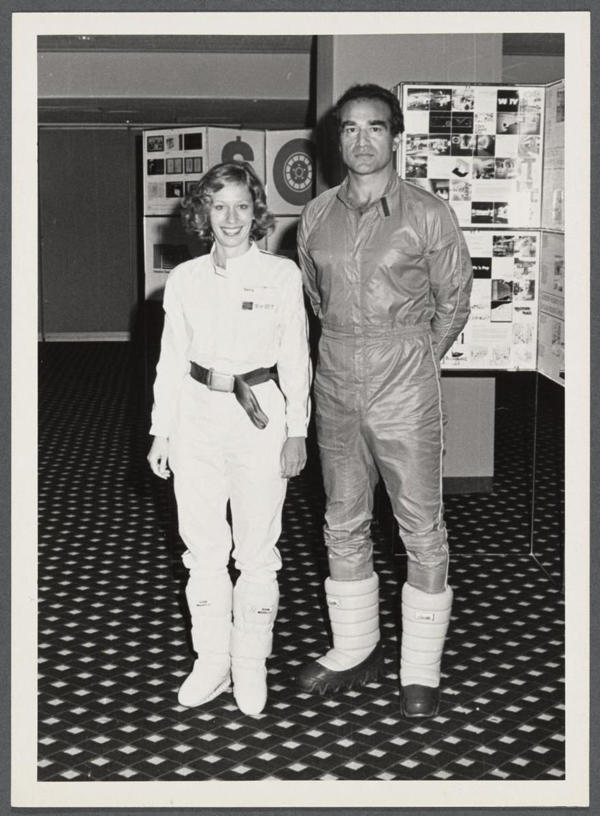
HA: Yeah, his archives are at NYPL. So many “research files” with clippings from science magazines, hundreds of images of space, satellites, spacecraft. So many press photos. He was very beautiful!
AD: Wait, who is this guy? What’s his actual name?
MV: Fereidoun Esfandiary. Though he did change his legal name. FM-2030 was like the OG transhumanist. He was part of the late 1960s wave of professional futurists, like Alvin Toffler, except he made it personal. In the 1980s he published a book called Are You a Transhuman? Monitoring and Stimulating Your Personal Rate of Growth in a Rapidly Changing World, which could almost have been written by one of our lifemaxxing billionaires today.
HA: His father was a diplomat, so he had a very peripatetic youth. He was born in Belgium. He wrestled and played basketball for Iran at the 1948 Olympics, then came to the US for university. He wrote about the absurdity of identity and borders. He also wrote about Palestine, about the absurdity of war.
MV: I think he was impatient. He was relentlessly optimistic. He liked to say that he was neither left nor right — he was… up. In 1973 he published a book called Up-Wingers: A Futurist Manifesto.
HA: [Laughs] It was hard to write the label. There is so much to say about this guy! His body is cryogenized somewhere in Arizona. We have a letter where he says, “Please don’t call me Fereidoun Esfandiary. My name is FM-2030.”
MV: He chose 2030 because that was the year he would turn 100 — far enough in the future, he thought, for his dreams to come true. You should do something for his centenary!
HA: You’re right…
MV: There really is something larger than life about him. About a lot of the figures you spotlight in the exhibition — FM-2030, Halim El-Dabh, Reza Abdoh…
AD: Hassan Ben Ali…
HA: [Laughs] It’s true. Different, in that those guys were really pushing against cultural stereotypes, where Hassan Ben Ali was definitely leaning in.
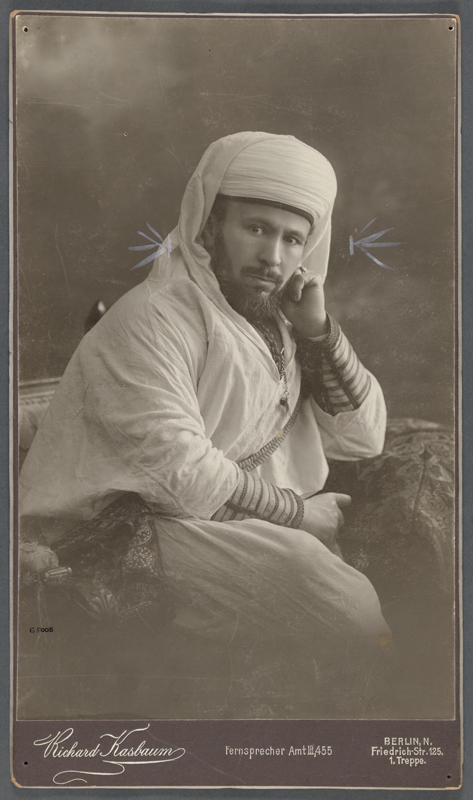
AD: He was a popular entertainer and cultural entrepreneur — such a colorful character! He managed a whole troupe of Arab acrobats in the late 19th and early 20th centuries, supplying the talent for that World’s Fair in Chicago in 1893, as well as for circuses and vaudeville performances. His troupe was very successful. They even performed on Broadway.
HA: Yes, The Garden of Allah, which was a huge production at the Century Theater in 1911. There’s a line in the program: “Berbers furnished by Hassan Ben Ali.” [Laughter] It’s interesting. There’s a story that this tradition of Moroccan acrobatics dates back to the 16th century, when Morocco was fighting Portugal. Some Sufi Brotherhood, I forget the name, would form human pyramids to scare off the Portuguese soldiers.
MV: Amazing.
HA: Yes. But it’s probably not true. There’s a lot of mythmaking around the acrobats, and that story is maybe too good to be true.
AD: You know, Hassan Ben Ali’s company was based in Coney Island. He had a whole camel collection. I’ve got a postcard…
MV: When you say, “whole camel collection"?
AD: An actual entourage of camels. I’d read about it in newspaper articles, but there was never any visual evidence of them. Then one day I went to a postcard show where they were selling vintage New York City postcards and there was one from 1911 with two camels on a beach in Coney Island. I was like, “Holy crap, these must be Hassan Ben Ali’s camels!” It was forty bucks — I bought it immediately. One article mentioned that his camels kept dying because he was getting them from Saudi Arabia and they couldn’t handle New York’s climate, so he had to switch to Siberian camels.
MV: What is the supply chain on a Siberian camel? Was there some sort of circus supply store?
AD: You know, Hassan Ben Ali teamed up with P.T. Barnum, whose circuses had an entourage of elephants. And actually — the story goes that the week after the Brooklyn Bridge was opened, there was an incident where someone tripped and the crowds panicked and like a dozen people died. New Yorkers, who were already anxious about this huge new suspension bridge — the first to connect Brooklyn and Manhattan — were too afraid to cross it. So Barnum said, “I’m going to make my elephants cross the Brooklyn Bridge. I have 21 elephants and they’re going to cross it twelve times.” His biggest elephant was named Jumbo and Barnum led a parade that included twenty-one elephants — and seventeen camels — across the bridge, with Jumbo in the rear, and it didn’t fall.
MV: Amazing. That might be the most public-minded thing that P.T. Barnum ever did.
AD: New Yorkers were like, “If it’s good enough for Jumbo, it’s good enough for me.”